

Microsoft just recorded the biggest market cap gain…ever.
$450 billion. Why?
And why did Meta just tank?
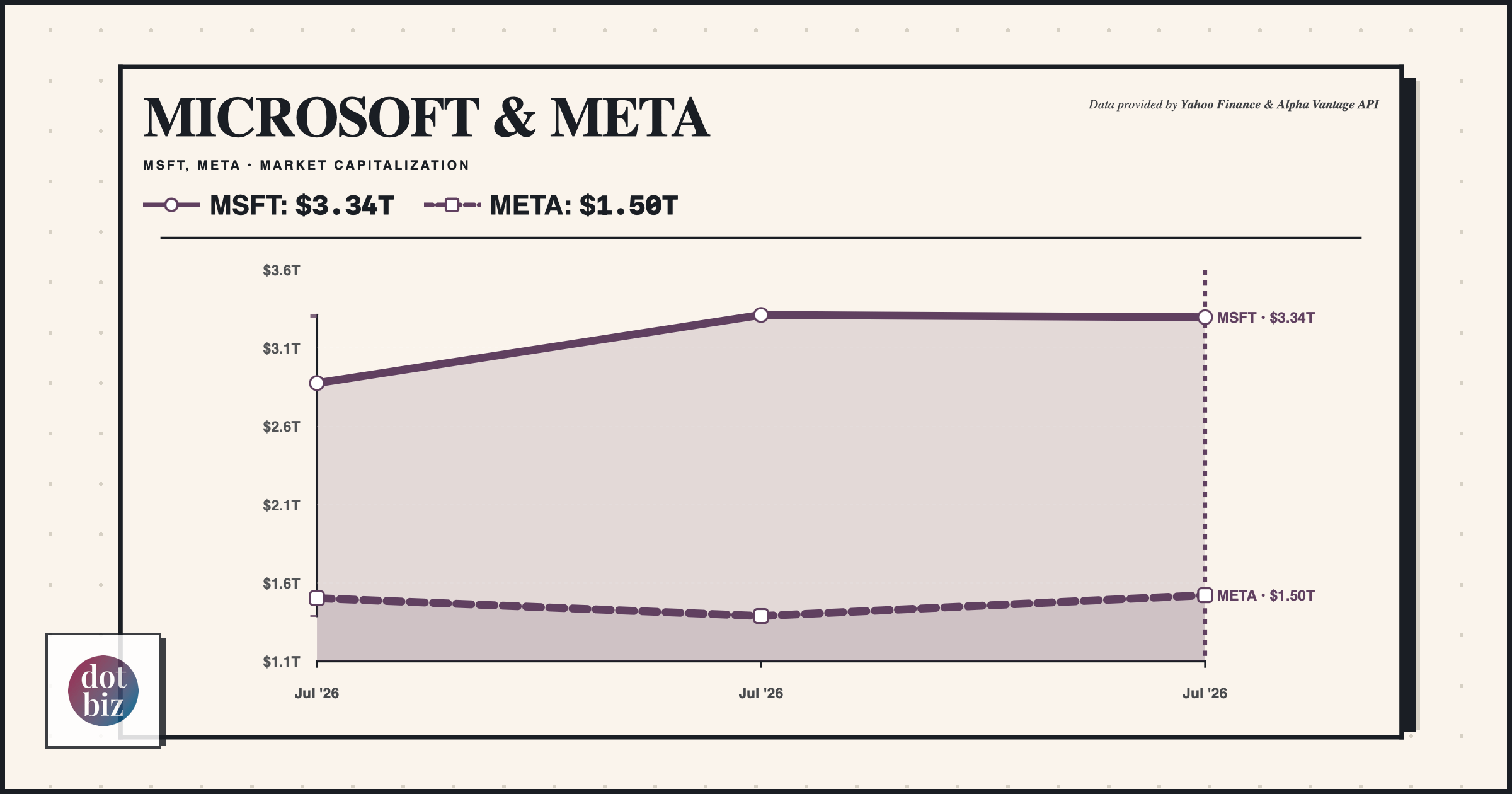
I actually made the above chart to show the mind-blowing swings for both companies, but it’s pretty underwhelming when considering their massive scale.
The Microsoft story is pretty clear, according to Microsoft CEO Satya Nadella in the press release accompanying earnings:
“This year, Azure revenue surpassed $100 billion for the first time, and Microsoft 365 Copilot reached over 30 million paid seats, reflecting the confidence customers are placing in us to power their AI transformation.”
I think it’s helpful to break down the storytelling in the earnings call. Though it’s a biased source — a little like asking a kid why his superhero is the most awesomest — the story obviously drove that mega stock bump.
Microsoft is anxious to differentiate itself as a cloud service provider, not a model provider.
We offer the broadest model catalog in the cloud.
In addition to keeping development costs down, it shows that their investments in, say, data centers, are likely to generate a return regardless of which AI model runs on them.
A lot of the frontier AI labs are approaching a Hollywood hits-driven business. Though it’s a big exaggeration, it’s not wrong to say that a hit or flop model can meaningfully affect company performance. Microsoft is happier to be the pipe — or the movie theater that can sprinkle some butter (Copilot) on the popcorn. Worry not, the analogy is now officially over.
Microsoft is still pushing on its own models, but the breadth of its investment shows that, ultimately, they’re happy to follow whatever model succeeds.
It’s also pushing enterprise success as a narrative. This list of companies is kind of a PR mishmash.
AstraZeneca, Boeing, Infosys, Koch Inc., Procter & Gamble, Stellantis, Tata Consultancy Services, University of Pittsburgh Medical Center, Wells Fargo, and Wipro each purchased 60,000 or more.
But having that list shows where Microsoft’s heart lies: serving corporate clients (i.e., not consumers), and doing so at scale.
That’s not to say Microsoft is getting all this for free.
Capital expenditures were $41 billion including the impact from higher component pricing as noted in our guide. Roughly two thirds of our capex was for short-lived assets, primarily CPUs and GPUs as customers increasingly build solutions that leverage both AI and non-AI infrastructure.
Still, all this tells a different story than the Meta Earnings call. There’s a lot to pick apart here, and some of it is likely just the relatively poor performance of Meta’s AI offerings finding a concrete moment to trade on. But this quote about Meta CEO Mark Zuckerberg’s vision is a contrast to the success of Microsoft.
So to build great personal agents, this needs to be a great consumer product that just works out of the box and is easy enough for billions of people to adopt and use.
It’s a bet on something it:
1) hasn’t yet made work that
2) people may not want.
Meta still has a killer business, with 28% year over year growth in its vast-majority ad business. But its quarterly expenses of $42 billion were up 55% on the year, and it missed expectations due, in part, to AI dreams.
And that, in short, is reflected in the stock dip.