

This week saw the launch of OpenAI’s first hardware product. Uh, sort of.
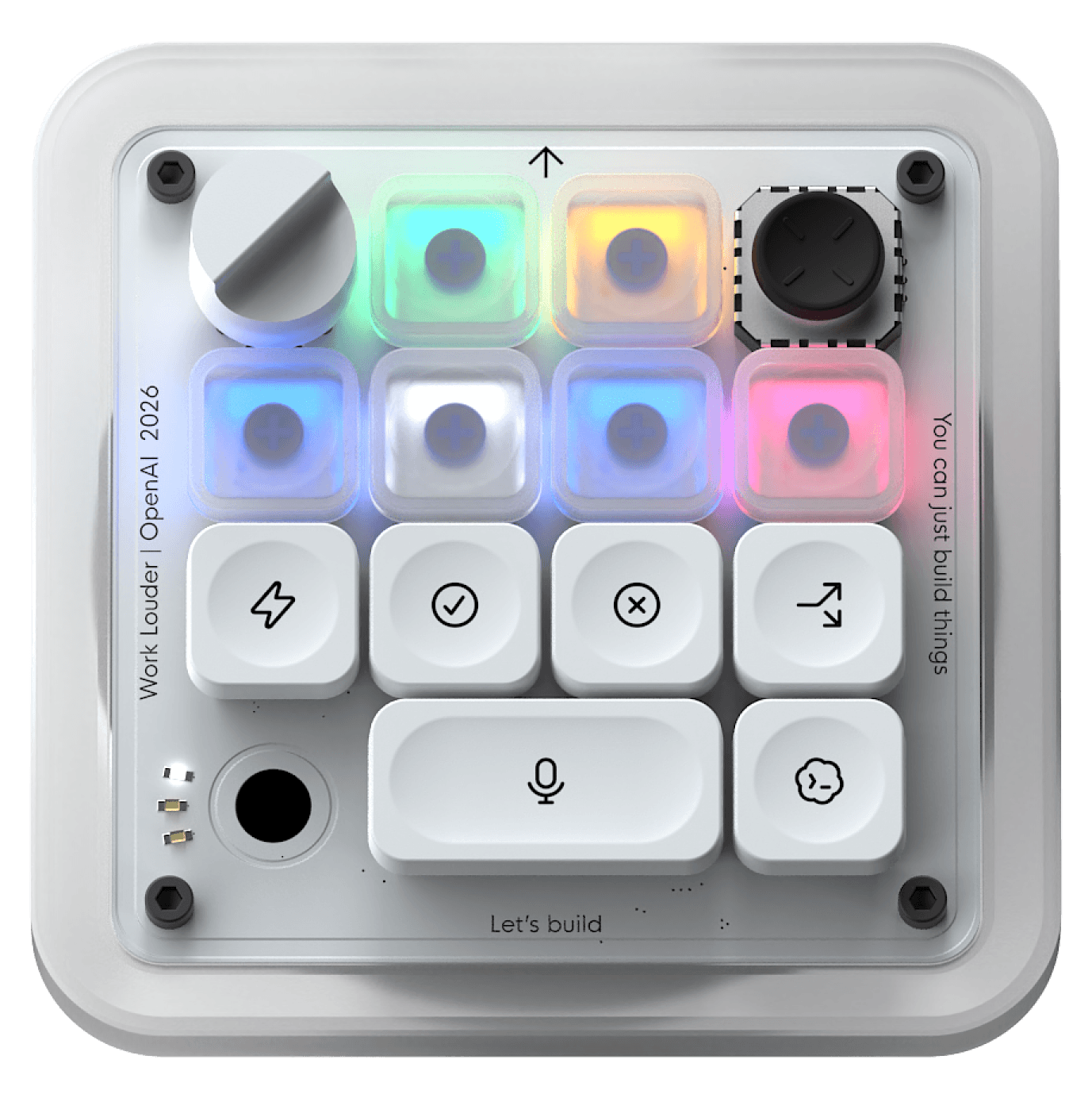
The Codex Micro is a “drop” akin to a YouTuber releasing a new t-shirt. It’s a “collab” with keyboard maker Work Louder that allows for some customization and integration between a branded (and IMHO under-thought) hardware device and OpenAI’s Codex. It’s more than a stunt (the ChatGPT basketball is a stunt). But it’s also less than a product, especially with that $230 price tag.
It makes more sense as a hyper-targeted play for the type of power-users — or power employees — influencing the perception and discussion of AI in the larger world. This extremely niche form of marketing is kind of the norm when it comes to the frontier AI labs. In the absence of big marketing campaigns, these attempts at subculture virality have become the main marketing message. AI sucks up so much oxygen that messages intended to appeal to a small sliver of the public end up being mass marketing.
This is most obvious in the “There’s hope in hard questions” ad that Anthropic put out. If you haven’t seen it, it includes a burning house and a shot of Arlington National Cemetery. Bizarrely, it aired during the World Cup. There’s an argument that Anthropic is following an Exxon strategy to get in front of the disaster (we’re the only people who can stop ourselves!) but I think it’s as likely that messaging conceived for a small audience — AI engineers worried about AI — inadvertently went from narrowcast to broadcast without a lot of thought.
And that’s the basis for the argument that we haven’t really seen a mass-AI ad campaign yet. It seems almost ironic considering that every company blathers about AI whenever the opportunity arises. But a coherent frontier lab campaign hasn’t happened, likely due to the prioritization of spending that money on computation power rather than brandshare. The messaging that does come out is intended for an audience of regulators, influencers, and potential employees.
Google and Apple might be the only adults in the room, because they already have big businesses that target those outside the Silicon Valley bubble. Frontier AI products have increasingly baroque and mythologically complex product naming schema (apparently GPT is cosmological now), but Google has helpfully simplified Notebook LM to Gemini Notebook. Apple’s Siri AI does use the dreaded “AI” branding (though it putatively stands for Apple Intelligence), but the name is irrefutably simple.
All this means we are still in the early innings of marketing AI to ordinary people. But companies might do well to exhibit some caution in how they sell to early adopters, because everyone is watching.